

Artifical Intelligence Is Not Just About The Trillion Dollar Companies
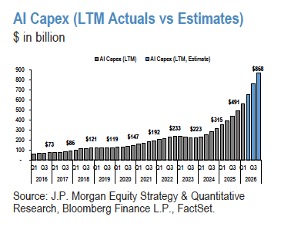
Articles and analysis regarding Artificial Intelligence (AI) are the topics du jour when looking at the global financial markets over the last several years. Capital spending has risen parabolically since 2023, and JP Morgan1 estimates $870 Billion in outlays by year end 2026. Total full year capital expenditure guidance from just five massive companies (Google, Amazon, Meta, Microsoft, and Oracle) is expected to be $751-$781 Billion during 2026, encompassing the vast majority of AI spending. JP Morgan analysts also expect Google, Amazon, and Meta to spend roughly $800 Billion on capital expenditures in 20272
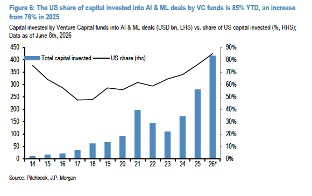
JP Morgan3 also estimates that the US shares of AI and Machine Language (ML) investments are dominating those from Europe and Asia, with 85% of venture capital invested being directed towards AI/ML compared to 6.5% in Europe, and 6.4% in Asia. This data does not include Chinese government investment in AI, given limited disclosures.
Does the race to dominate and harness AI extend to smaller companies? The answer is a resounding yes. Investment and adoption are already occurring across companies in our portfolio and our universe of potential candidates.
In the Consumer Staples sector, one portfolio company is implementing SAP S/4HANA, a new enterprise resource planning (ERP) system with built-in AI capabilities, including Joule, an AI copilot, and an Intelligent Scenario Lifecycle Management (ISLM) module. The system also embeds machine learning for predictive tasks, improving data quality for management.
In Financials, the investment banks held in our small-cap portfolio have all discussed AI implementation on recent investor conference calls. They are using AI tools to improve internal productivity and generate corporate strategy ideas that bankers can pitch to clients. The commercial banks in our portfolios are also using AI in myriad ways, including customer acquisition, customer service, and credit analysis. One company noted that AI has helped significantly in the integration and conversion of systems in several recent acquisitions.
In the staffing industry, which has come under significant pressure from fears of AI disruption, one of our holdings indicated that AI will be additive to their business rather than disruptive. The company indicated that as many as 75%-80% of operational roles have already been automated. Furthermore, AI proliferation has resulted in a surge of applications and made it more difficult for companies to evaluate the reliability of resumes.
Industrial companies are incorporating AI and robotics to build smart factories that are flexible. Predictive AI is being used to simulate complete factory floors which allows companies to stress-test layouts before configuring the factory. AI co-pilots help human workers troubleshoot machinery using natural language, while continuous sensor monitoring instruments predict equipment failures before they cause costly downtime. Modern robots leverage machine learning and computer vision to adapt to new tasks, navigate factory floors via self-driving vehicles, adjust production lines in real time, and inspect products for flaws at superhuman speeds.
Within the Information Technology sector, several portfolio companies produce products that are used in hyperscale datacenters and in the production of memory chips. One portfolio company in the software and consulting sector indicated that AI deployment has driven a significant increase in revenue per non-billable headcount and that continuing investment in AI tools are accretive and margin-enhancing. However, the ancillary effects of the AI Boom have led to increased volatility in their share prices as investors seek to ascertain how much of a good thing has already been priced in, and how long will the good times last.
AI adoption is accelerating in our small cap universe and helping the companies improve productivity and efficiency. In his book “AI Super-Powers: China, Silicon Valley and the New World Order”4, Kai-Fu Lee asserts that the quantity of data is the core element for successful AI algorithms, rather than elite engineers and massive computing power. Since data availability continues to accelerate and computing costs decline, the economics of accessing AI algorithms will improve and allow small cap companies to implement more sophisticated data analytics and modeling techniques. These in turn will lead to increased efficiency and revenue growth opportunities over time.
There are aspects of the AI investment discussion that remind investors of the mania of the Tech Bubble in the late 1990s and the subsequent Dot-Com bust of 2000-2002, in which the NASDAQ fell more than 75%. As value investors during that period, it was a difficult time to discuss investments generating strong free cash flows and above average rates of return on invested capital (ROIC). We will follow our discipline and seek out those companies with attractive valuations, solid balance sheets, and strong internal rates of return. We remain long-term investors and will leave speculation to others.
1 Dubrakvo Lakos-Bujas et al. JP Morgan US Equity Strategy. 10 August 2026
2Ibid, page 2.
3 Fabio Bassi, et al. JP Morgan 2H 2026 Outlook 12 June 2026.
4Lee, Kai-Fu. AI Super-Powers: China, Silicon Valley, and the New World Order, page 14.